Showing posts with label Options. Show all posts

Tuesday, 16 August 2011

Laser Devices Offer New Treatment Options for Toenail Fungus


Studies have shown that nearly 35 million people in the United States and 700 million across the planet endure the pain and embarrassment of toenail fungus (onychomycosis). Historically, there were limited options for treating fungal nail infections. Topical treatments fail to cure toenail fungus in a majority of cases. Oral antifungal drugs are more effective, particularly the newer drugs such as terbinafine and itraconazole, but present health complications in some patients. In light of the problems of conventional remedies, companies are seeking to develop new ways to treat onychomycosis through technology. Now, sufferers of toenail fungus have a new option to treat the age-old problem -laser treatment.

Though using lasers for treating toenail fungal infections is very new, and still undergoing FDA trials, laser treatments offer a promising cure for the dreaded condition.

Currently, no laser devices have received approval from the United States Food and Drug Administration (FDA) specifically for use in treating nail fungus. There are two laser devices that are being touted for their ability to cure these fungal infections. One laser device has been approved for dermatology and plastic surgery while the other is in what its maker hopes is the final stages of FDA approval. The two competing systems are:

ThePinpointe FootLaserhas received FDA-clearance for use in dermatology and plastic surgery. Since the laser has not been approved by the FDA specifically for the treatment of nail fungus, using the laser to treat nail fungus is an "off-label" use. What that means is that doctors and podiatrists may use the laser to treat toenail fungus, but the manufacturer of the laser, Pinpointe USA, Inc., cannot market or promote the device to perform that function in the U.S. Pinpointe is seeking FDA approval to market the device to treat onychomycosis and has submitted studies to the FDA to support that use.

Another laser device, the Noveonlaser manufactured by Nomir Medical Technologies has received clearance from FDA for use during contact and non-contact surgical procedures of the skin, subcutaneous tissues and nasal passages in dermatology, plastic surgery, podiatry, and otolaryngology. However, like the Pinpointe laser, the Noveon laser has not been specifically approved for use in combating nail fungus.

How Do Lasers Cure Toenail Fungus?

The two laser devices both work by shining specific wavelengths of near infrared light through the nail plate of the toe or finger. The light from the laser eradicates the fungus, yeast or mold that are under the nail plate and which are causing the infection. The laser light has no effect on the surrounding healthy tissue. There is no pain but some patients experience temporary warmth in the nail during treatment.

Are Laser Treatments Effective?

PinPointe reported that in a clinical trial, 88% of the treated patients grew out a normal looking nail after a single laser treatment. Nomir has stated publicly that in one study its Noveon laser therapy treatments resulted in 87% clinical improvement. Both of those results are significantly higher than were found in clinical studies of terbinafine, the most effective pharmaceutical drug for onychomycosis.

The results reported by the laser device manufacturers appear quite promising, these results are based on very small study sizes and the manufacturers' studies may not meet the rigorous standards of the studies conducted on the pharmaceutical drugs. In addition, since the use of the laser devices in treating nail fungus is a very new technology, there is no data on the long term effectiveness of the treatment or the reoccurrence of the nail fungus following the completion of the laser treatment.

In conclusion, the initial reports seem to point to laser therapy as the most effective available treatment of onychomycosis, but much more data needs to be acquired before it can be established that the laser devices offer a viable alternative to the current remedies for toenail fungus.


Marshall DeSoto is a freelance writer. He has written on laser treatments for toenail fungus, home remedies for toenail fungus and similar topics of interest to people who suffer from this ugly and painful condition.


This post was made using the Auto Blogging Software from WebMagnates.org This line will not appear when posts are made after activating the software to full version.

Sunday, 14 August 2011

Laser Scar Removal - What Are the Options?


If you are considering laser scar removal, you'll have several options to choose from. There are many different lasers used, although they work in several common ways. The laser technologies vary in how much they can penetrate your skin. Those with longer wavelengths can penetrate the skin deeper. If you have severe scarring, you'll need a more intense laser or more treatments. All of your laser options are very precise, with a short recover time after the treatment.

Your choices for laser technology include nonablative lasers, such as pulse dye lasers and N-Lite lasers, which cause collagen to form under the skin. This can reduce redness and fill in indented scars. Other lasers, called ablative lasers, are most often used when you have a raised scar. These vaporize the top layer of skin, exposing younger and healthier skin. They work in much the same way as sanding a tabletop. The laser types offered include CO2, Erbium, and Nd:YAG lasers. CO2 was one of the earliest laser types successfully used for scar reduction, but it has fallen out of favor for newly developed technologies. Still, many doctors keep using these older lasers; make sure you understand the laser technology offered by your doctor. These lasers are offered under many different brand names, so ask your doctor about the specific lasers offered, as not all laser scar removal providers use all of the possible types of lasers.

To choose the right laser for your situation, your doctor will evaluate the type and severity of your scar. There are three main types of scars: keloid, atrophic, and hypertrophic. All three can be treated using laser scar removal, but different types of lasers are developed to work on different kinds of scars.

In order for your treatment to be successful, choose a doctor who understands the differences between the lasers and can select the right one for your situation, since each laser type is not equally effective on all types of scarring.

Once your initial treatment is over, you'll also have the option of addition treatments to further improve the appearance of the scar. After any number of treatments, you can discontinue laser scar removal treatments if you find that your scar has achieved a satisfactory appearance. Most patients undergo three to six procedures, although you may need as many as eight, particularly if you have severe scarring. Eventually you will begin to see diminishing results from additional treatments.


Margaret Richards is the author of the Laser Scar Removal Guide. Get more advice about what to expect, how to choose the right laser scar removal center, discover the advantages and benefits, the possible risks and side-effects of the procedure and the options for laser scar removal.


This post was made using the Auto Blogging Software from WebMagnates.org This line will not appear when posts are made after activating the software to full version.
Saturday, 13 August 2011

Laser Hair Removal - What Are My Options?


If you are considering laser hair removal, you may not realize the number of decisions involved. First, of course, you'll have to determine the exact area you wish to treat. Some providers will give you discounts for treating a large area, but also keep in mind that a larger area will take longer to treat.

Now, you'll need to schedule consultations with several doctors. Of course, the options depend on your location. Find a doctor who uses the latest technologies and is fully trained using the laser system. While there are other options, including salons and spas offering hair removal using lasers, your best option is a reputable and fully trained doctor. Choosing a reputable doctor will help to lower your risk of side effects. Discuss the options with several different laser hair removal doctors to determine which one can offer the best treatment options to you.

The success of your treatment depends not only on the doctor, but also on the laser being used. Once you've decided which areas of the body will be treated, you'll need to decide what technology will be used during your treatment. Schedule a consultation with the dermatologist you have chosen. He or she will be able to evaluate your skin and hair type to recommend which lasers will be most effective for you. Newer lasers are more effectively able to treat people with darker skin colors, while older laser types are only effective at treating people with very pale skin. Make sure that the doctor you choose offers the latest lasers so that your treatment will be as effective as it can be.

Laser beams used for laser hair removal are all used the same way, but the actual lasers differ greatly. Some are in the visible light spectrum, while others are nearly infrared. The wavelength affects the skin and hair colors the lasers can treat effectively. Some of the lasers include ruby, alexandrite, and diode lasers, as well as intense pulsed light, or IPL, systems. These lasers are not as effective on dark hair as newer lasers, like the Nd:YAG laser, which can be used safely on very dark skin tones.

Your doctor will help you decide not only the laser being used, but also the size of the laser beams. Lasers can be used to remove an area of hair 18mm in diameter, which is faster for treating large areas. However, with smaller areas you'll want a smaller laser for more precise hair removal.

You have many options when considering lasers for hair removal. A skilled professional will able to help you navigate all of the choices. These variables can all be adjusted to change the results you will receive after your laser hair removal procedure.


Louise Bently writes about home laser hair removal, an essential resource for those considering laser hair removal in the comfort of their own home. Find out the answer to: Is home laser hair removal right for me?


This post was made using the Auto Blogging Software from WebMagnates.org This line will not appear when posts are made after activating the software to full version.

Thursday, 28 July 2011

The Best SEO Training Options


Search engine optimization (SEO) is one of the most cost-effective forms of Internet marketing. If you're reading this article, it's most likely because you're on a quest to decipher the world of SEO and you need help. Fortunately, there's an array of training formats and services that you can take advantage of to learn the art and science of SEO.

Static Versus Interactive Options

As you go through the various options discussed below, it's important for you to realize that SEO will appear to be a very nebulous approach to Internet marketing. The history of SEO is complex and you're going to have a lot of questions. That said, I've divided the SEO training options into 2 types: Static and Interactive.

Static options consist of a series methods to learn SEO by someone telling you what to do. It's very limited because of the uni-directional nature of the information. In other words, the information flows in one direction: From the source to you. You can get something out of these methods but don't expect to get to an advanced level. A book, for example, can only take yo so far in this field.

Contrast this with interactive options which are the best case scenario. Why? Because you want to get feedback from an experienced professional while you're learning.

Static "One-Way" Options

You can learn from these but don't expect feedback.

SEO Books

There are SEO books available but they all have one major flaw: They get dated quickly. You might be able to get a general overview of SEO as well as some worthwhile techniques but knowing why you're implementing specific techniques is just as important as knowing how to do so. A lot of books won't cover the "why" and will simply tell you to do use this technique or that method.

SEO Software

While a number of software options exist, few will teach you very much. Sure, the companies that produce these products will tell you everything you want to hear and boast about how easy it is to use their software but if you don't know what the information means, you won't get far. SEO software may be useful as a tool but it will never replace true knowledge. I woldn't recommend it as teaching tool. Your marketing is just too important.

SEO Videos

A few companies have developed SEO video tutorials. These may answer some of your questions but you'll never get the most current, big picture. Also, you're typically relying on one approach to the subject. What if you want multiple perspectives on the best way to use a given technique? You probably won't find it here.

Video Tutorials

You can find short video tutorials on YouTube for basic ideas but you'll need someone to help you put it into context. For example, you can watch a video on using directories for link building but you wouldn't necessarily be made aware of the fact that it's a somewhat dated concept that is only used as part of larger linking campaigns nowadays, if at all.

Slideshow Presentations

Some websites like SlideShare have PowerPoint presentations with general guides to topics like SEO. You may be able to learn something from them but they are often too vague to be of any value to the novice student.

Conference Tutorials

In some cases, you may be able to find videos or other media summarizing SEO conference sessions where key ideas have been discussed. Again, the lack of context could make it difficult for a novice to follow. Still, some good ideas that you haven't thought of or come across may be provided so this could be worthwhile for continuing education.

Interactive Options

The best SEO training options are always the ones with highly qualified trainers who have experience teaching. Your Internet marketing shouldn't be left to amateurs or one-sided debaters. It's just too important, especially in today's competitive technologically-savvy world. Do you want a taxi driver who got his license yesterday or a few years ago? Would you prefer to hire a lawyer who graduated last week or one that has years of experience on cases just like yours?

Blogs & Forums

While blogs and forums seem like great places to learn SEO, they are actually full of people who have no idea what they are talking about. I wouldn't recommend these for people who are just beginning to learn about SEO. They're much better suited for individuals who have some basic experience and know how to differentiate the non-sense from reality.

One-On-One SEO Training

In this format, you can learn SEO by hiring a professional to walk you through all of the important steps you need to achieve master-level results. This is the best option for anyone who wants to truly learn what it takes to get to the top, convert visitors, and retain them.

Corporate SEO Training

Larger companies have unique needs, such as bringing individuals and small teams from different departments together to learn about SEO. If they don't have someone in-house, they could benefit from having an experienced expert teach a workshop.


* Copyright 2009, Brian Rotsztein. You may only republish this article online provided you keep the byline, the author's note, and the active hyperlinks.

The author of this article, Brian Rotsztein, has been working with clients since the 1990s. He has helped businesses achieve incredible return-on-investments with their Internet strategies. This professional SEO and Internet marketing consultant trains everyone from small businesses to large corporate teams. You can read more original articles on his blog Purposive Internet Marketing which consists of experience-based ideas.


This post was made using the Auto Blogging Software from WebMagnates.org This line will not appear when posts are made after activating the software to full version.

Friday, 22 July 2011

Google Adds URL Parameter Options to Google Webmaster Tools

In 2009, Google launched the parameter handling feature of Google webmaster tools, which enabled site owners to specify the parameters on their site that were optional vs. required.  A year later, they improved this feature by providing an option for a default value. Google says that they’ve seen a positive impact from the usage of those tools thus far.” Now, they’ve improved the feature again, by enabling site owners to specify how a parameter changes the content of the page.

My original article on parameter handling describes the issues that parameters can cause with how search engines crawl and index a site. In particular, as the parameters multiply, the number of near duplicate pages grows exponentially and links may be coming in to all of the various versions. This dilutes PageRank potential, and the “canonical” version of a page may not ending ranking as well as it otherwise would. Search engines may also spend much of their crawl time of various versions of a small subset of pages, preventing them from fully crawling (and thus indexing) the site.

So what’s new? You can now specify whether or not a parameter changes the content on the page. For those that don’t, once you specify that, you’re done! Things get more complicated if a parameter changes the content on the page. You now have a number of options available, described in more detail below. This latest incarnation of the feature impacts both which URLs are crawled and how the parameters are handled.

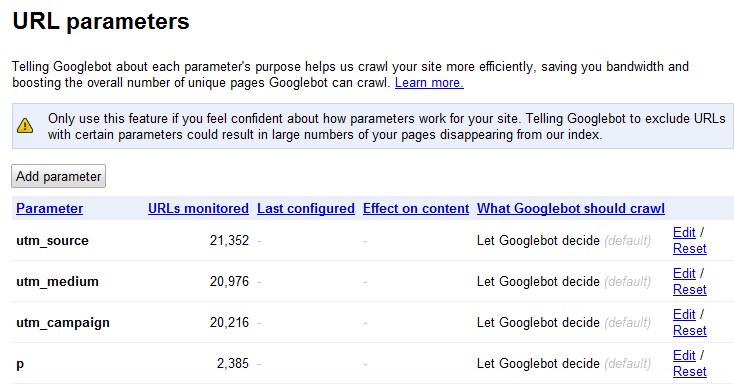
To access the feature, log into your Google webmaster tools account, click on the site you want to configure, and then choose Site configuration > URL parameters. You’ll see a list of parameters Google has found on the site, along with the number of URLs Google is “monitoring” that contain this parameter.

URL Parameters

The default behavior is “Let Googlebot decide”. This results in Google figuring out duplicates and clustering them. As they say in their help content:

“When Google detects duplicate content, such as variations caused by URL parameters, we group the duplicate URLs into one cluster and select what we think is the “best” URL to represent the cluster in search results. We then consolidate properties of the URLs in the cluster, such as link popularity, to the representative URL. Consolidating properties from duplicates into one representative URL often provides users with more accurate search results.

To improve this process, we recommend using the parameter handling tool to give Google information about how to handle URLs containing specific parameters. We’ll do our best to take this information into account; however, there may be cases when the provided suggestions may do more harm than good for a site.”

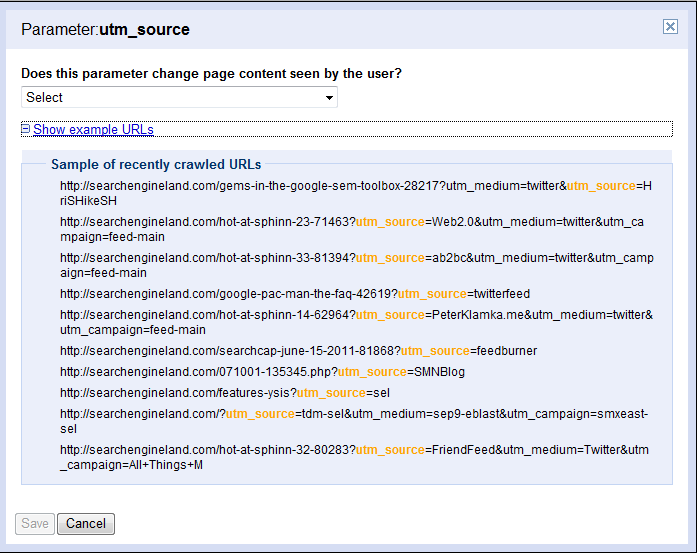
But if you want to have some control over that process, click Edit to specify whether that parameter changes the page content. You can look at a list of recently crawled URLs with that parameter to help you figure out what they’re used for.

Google webmaster tools parameters

Your choices are:

No: Doesn’t affect page contentYes: Changes, reorders, or narrows page content

If you choose no, you see the following message:

Select this option if this parameter can be set to any value without changing the page content. For example, select this option if the parameter is a session ID. If many URLs differ only in this parameter, Googlebot will crawl one representative URL.

Google will associate any URLs with those parameters with the versions without them. So for instance, if Google comes across the following two URLs, they’ll cluster both together as the first URL:

www.mygreatsite.com/buffy-is-still-awesome.phpwww.mygreatsite.com/buffy-is-still-great.php?referrer=buffyangelship4eva

If you choose Yes, you see even more options.

parameters

Sorts – the content stays the same, but is reorderedNarrows - the parameter is a filter that displays a subset of the contentSpecifies - the parameter determines the page contentTranslates - the page content appears in a different languagePaginates - that parameter indicates the page number of a larger set of contentOther - none of the aboveLet Googlebot decide -this is the default; Google will use other signals to determine which URLs to crawlEvery URL - Google should crawl all URLs and use the value information above to choose what to consolidateOnly URLs with value – triggers a list of values Googlebot has crawled to  choose from; use this option if you want Google to crawl only URLs that contain a specific value for a parameter (and not crawl any others)No URLs – you don’t want Google to crawl any URLs with this parameter (but not that using a pattern match in robots.txt may be better option in this case)

Handily, Google shows you how your choices will impact crawling:

parameters

Seem overwhelming? Fortunately, another new feature Google has launched is the ability to download all of the parameter settings as a CSV file so you can sort though them offline.

As Google notes on the page, “Only use this feature if you feel confident about how parameters work for your site. Telling Googlebot to exclude URLs with certain parameters could result in large numbers of your pages disappearing from our index.” The benefit, though, is multifold. The crawl is more efficient, so more pages of the site may get crawled and therefore indexed, and links are consolidated to a single version that may then gain rankings.

My guess is that Google may not immediately stop crawling the pages, as they may want to make sure the content is in fact the same before consolidating the URLs into a single version. But if you aren’t an expert with URL parameters and canonicalization, you probably want to let Google sort this out and not change these settings. They do, in fact, do a fairly good job, particularly when URLs use standard key-value pairs.

If you know the ins and outs of URL parameters and know exactly what you want Google to crawl, then go for it. Jonathon Colman of REI jumped on these new features right away!

jcolman

jcolman

Should you use this feature if you’re already using the rel=canonical attribute on the pages? Sure! Google’s help says:

“You can also give Google additional information by adding the rel="canonical" element to the HTML source of your preferred URL. Use which option works best for you; it’s fine to use both if you want to be very thorough.”

I still have questions about this feature, like how it impacts a crawlable link architecture with substantial pagination. If you’re interested in digging as well, note that I’ll be moderating a session on this at SMX East, and Maile Ohye of Google, who’s spent a lot of time on this issue, as well as experienced practioners, will be on hand to provide practical answers.

Related Topics: Features: Analysis | Google: Webmaster Central | SEO: Duplicate Content

About The Author: Vanessa Fox is a Contributing Editor at Search Engine Land. She shares her perspectives on how search impacts marketing, user experience, and web development at ninebyblue.com. Her book, Marketing in the Age of Google, provides a blueprint for incorporating search strategy into organizations of all levels. Follow her on Twitter at @vanessafox. See more articles by Vanessa Fox

SMX - Search Marketing Expo

View the original article here


This post was made using the Auto Blogging Software from WebMagnates.org This line will not appear when posts are made after activating the software to full version.